Last Saturday I attended a writer’s workshop at Book People, sponsored by Mystery People and the Austin chapter of Sisters In Crime. I honestly didn’t think I’d learn much new. But I was wrong. *Note- Between classes we had drawings for giveaways like books and tote bags!
It started with George Wier speaking about writing action scenes. He’s literally a pro at this. Just read any of his books. (www.billtravismysteries.com) It wasn’t about how to describe a blow-by-blow fistfight. It was more about how to add tension to a scene, how to make it move along. I don’t know about you, but I like bullet points. So I’ll share my notes in that manner.
Before you can add action, you must put the reader in the moment. They won’t follow anything if they aren’t there. To accomplish this, describe the lay of the land and the surroundings.
What are the results of the action? There should be consequences or the reader won’t care.
The scene must have a beginning, middle, and end.
Don’t describe things in terms of time. (aka- three hours later). Believe it or not, that doesn’t do anything for the reader. Time isn’t as tangible as distance. “They walked down a flight of stairs.” Is much easier for the reader to see and instantly understand.
Perception is everything. Use all the senses. Have your characters be aware of their breathing, their surroundings, sounds, pain, everything.
The idea of writing about distance instead of time interests me. All of the things listed above make sense, but the idea that the reader can intuitively understand distance better than the concept of time is fascinating.
Scott Montgomery of Book People recommended the book, The Killer Inside Me by Jim Thompson. He said it was a good example of what Wier was talking about.
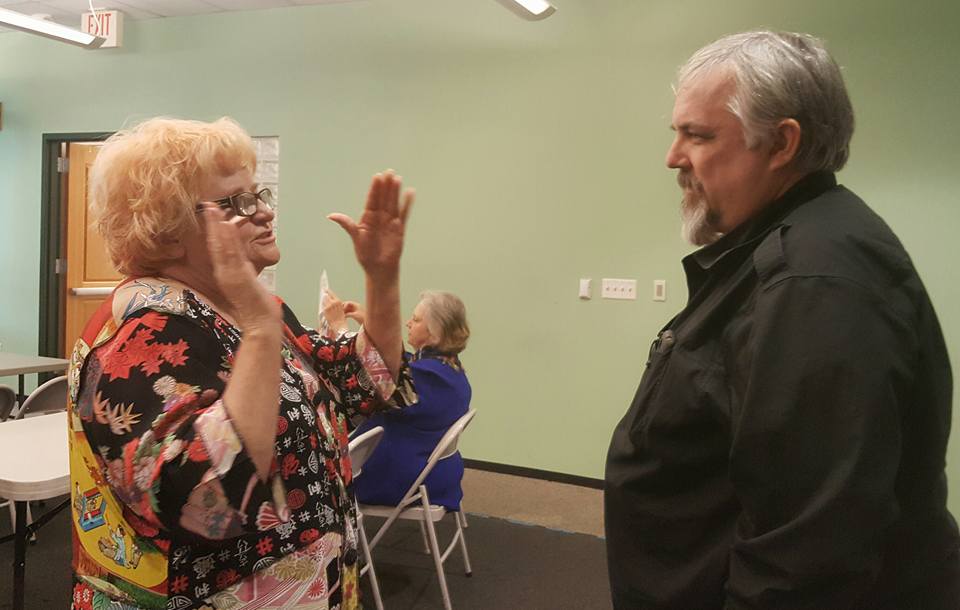
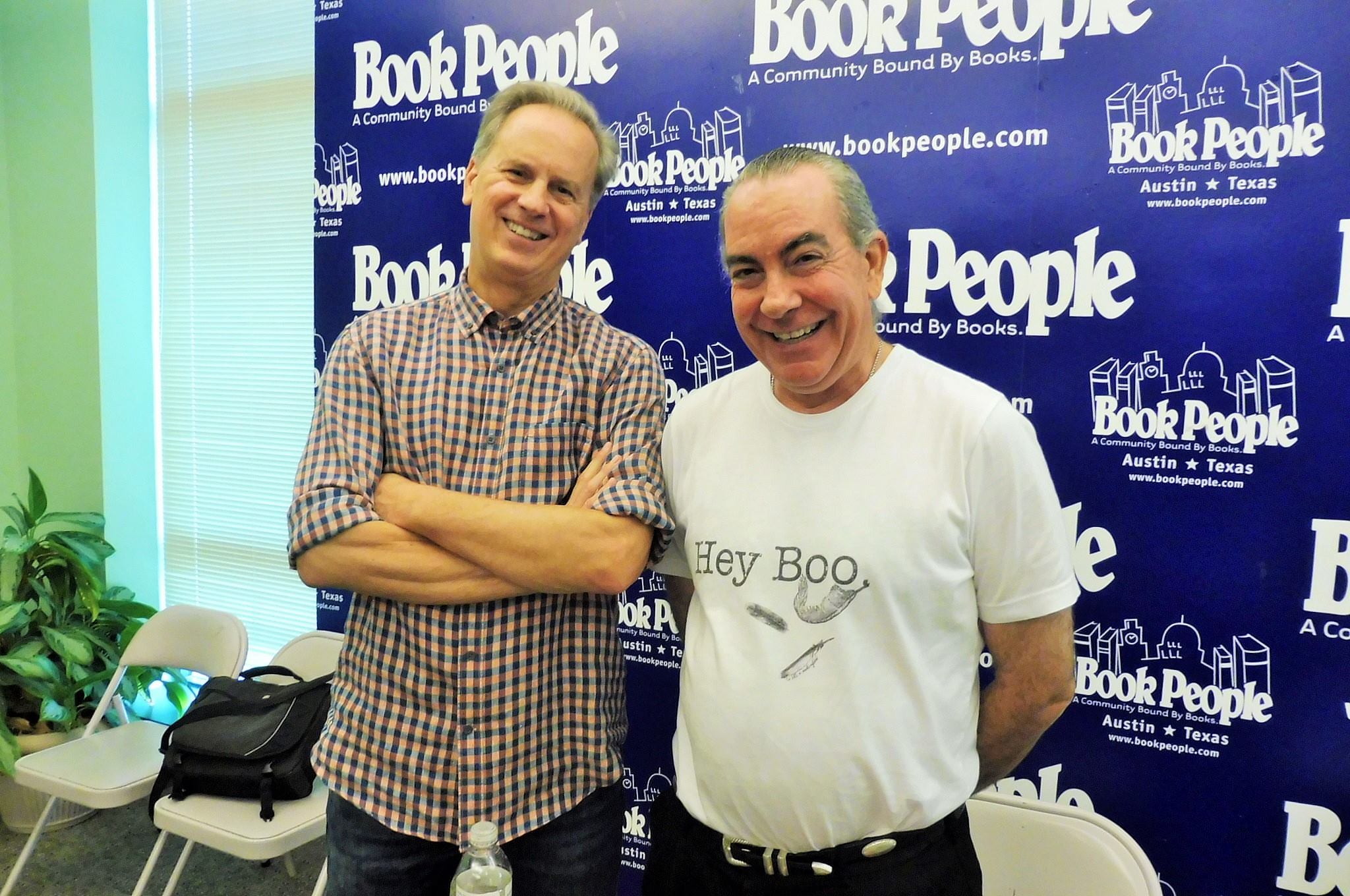
Cutting up between classes. Friend and author Billy Kring dropped by. He’s trying to distract me while George Wier looks on.
The guys behaving for Terry’s talk.
Next at the workshop was Terry Shames. She gave us many tips on how to writing compelling settings. And she should know. She does an excellent job of describing the Texas town where her Samuel Craddock series takes place. (www.terryshames.com) I came away with the concept of interior settings and exterior settings. No, not what a living room looks like, interior as in what’s going on inside a character. (More bullet points!)
Treat your scenes as characters.
The way to make your story interesting is to show how the interior setting (of characters) intersect with the exterior setting. How would someone from a Texas ranch interact with the people and setting of New York city? How would that same person act in their own hometown?
The devil is in the details. Immerse the reader in the setting. You don’t have to do an information dump. (Please don’t.) But you can provide things like smells and sounds.
If you aren’t familiar with a place, research it. Talk to people who know the place.
Above all, know how your characters would interact with the setting. Someone who almost drowned would have a different reaction to falling in the water than someone who is an Olympic swimmer. So Know Your Characters!
Every scene should try to have-
Action
Dialogue
Physical description of setting
Physical description of characters
Internal thinking
Internal physical descriptions.
A good rhythm of a scene would be: 2/1/2, 4/3/5, 6/2/1. Try it and see what happens.
Brent and James. Looking forward to reading their books.
After lunch we gathered for the last class about collaboration. Brent Douglass and James Dennis, two of the three authors who make up the persona of Miles Arecenaux (www.milesarceneaux.com), led a funny discussion on their journey of collaborative writing. They started their first book back in the days before email. Thank goodness the days of mailing a manuscript back and forth are gone. Thank you email! So what are their tips?
Don’t be afraid to be honest with each other. Actually, they said to be brutally honest. Treat each other like siblings.
Play up to your partners’ strengths. You are different people with different experiences. You that to your advantage.
Work to maintain “one voice” for your book. It will get easier with practice but it will also take many edits to achieve this.
Defer to people with experience. (Again, take advantage of your partner’s strengths.)
It helps to build accountability. If you know that you’re expected to get your part done by a certain time and the others are counting on you, you better do it.
Broadcast gratitude. Not only show gratitude to your partners, show gratitude to other writers.
(Collaborating sounds interesting. I think I’d like to take a stab at that just for fun.)
The last event was a panel discussion that was very informal. It was about publishing, marketing, and networking. Honestly, I was so caught up in listening, I forgot to take notes! All the speakers were charming, personable, and informative. It was worth every moment that I was there.
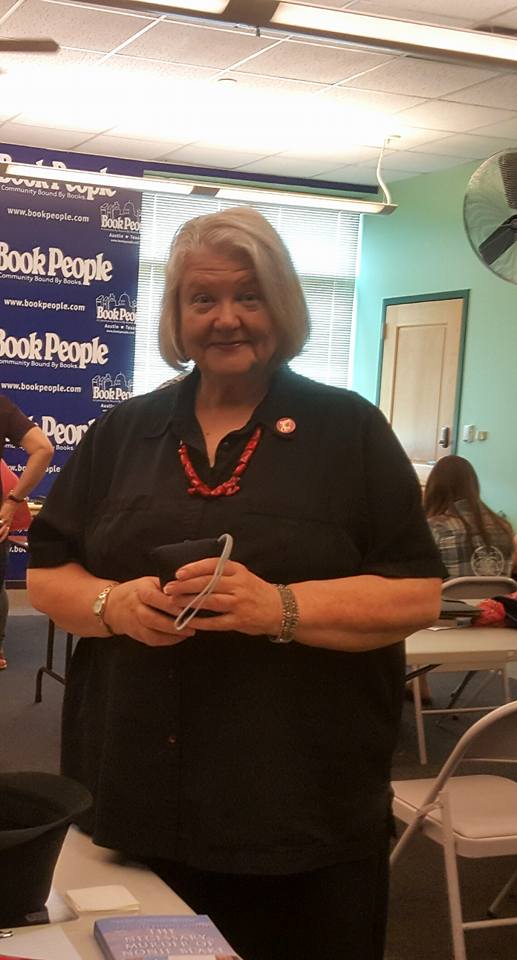
Gale Albright helped put it all together and did the raffle.
George answering questions between classes.
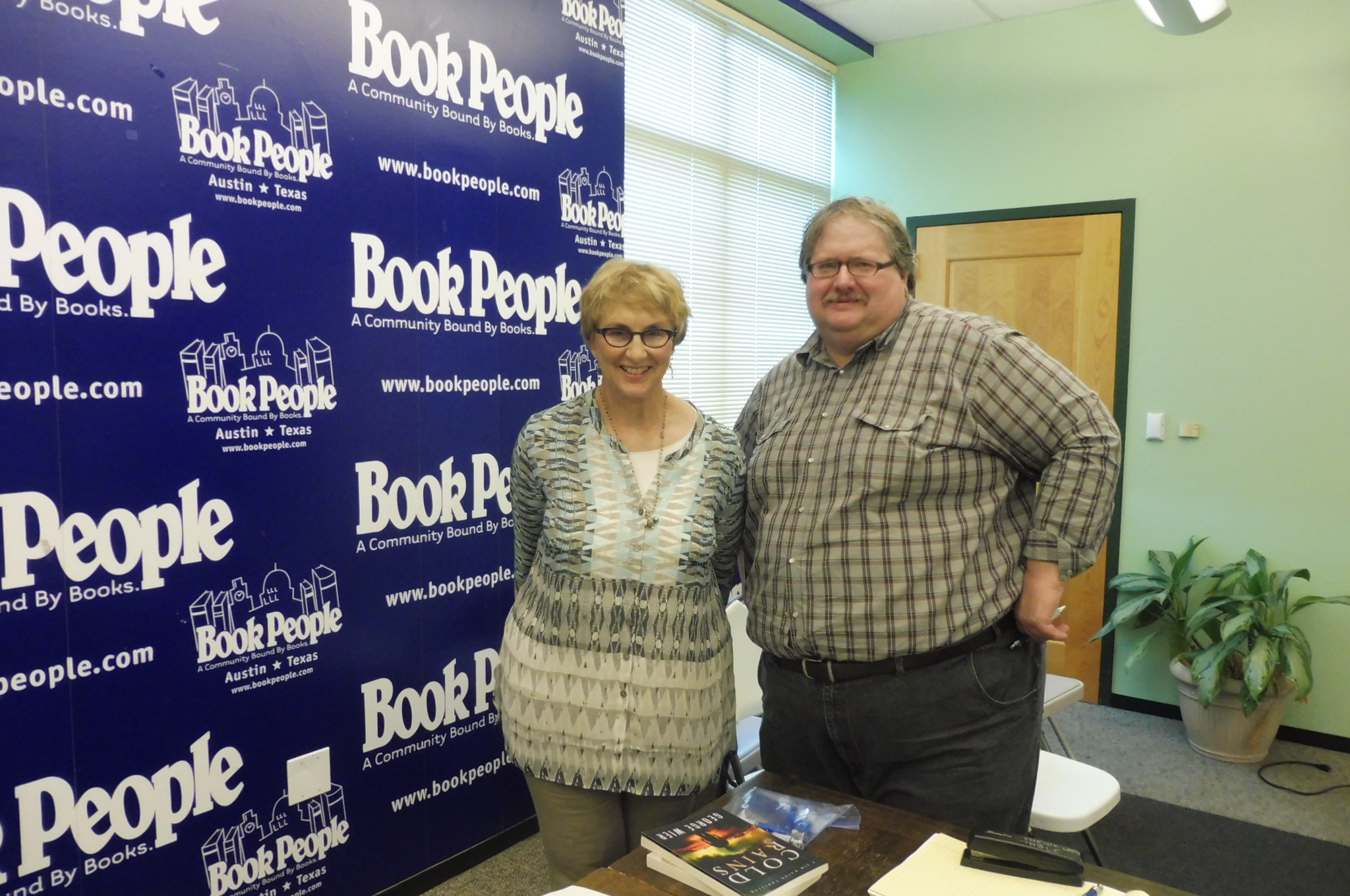
Terry and Scott
I’d like to say thank you to Book People and Scott Montgomery of Mystery People for hosting us!
Today I joined Austin Mystery Writers members Kathy Waller and Gale Albright at the Hutto Library for the first annual Local Author and Artist Reception.
Waiting for the crowd!
It was a lot of fun and they rolled out the red carpet for us. Paula, one of the librarians, is so nice and enthusiastic. She made us all feel special.
Paula had crazy boots too!
This was the first book selling “event” I’ve ever been to.
I made some keychains.
We sold a few copies of Murder on Wheels and it was fun meeting the other participants.
We’re bandying about the notion of doing another anthology. So stay tuned!
For now we’re having fun promoting and hawking MOW.
What do you mean you haven’t bought a copy? Buy one! Or else…
You know how some songs are more appealing than others? They just seem to have that “something” that people like. I think the same thing is true for books. Obviously a book should have good writing, unlike some blockbusters. But I won’t be tacky and mention anything about supernatural animals or domineering billionaires. Nope, I won’t stoop that low. My inner goddess says it’s not polite.
I’ve recently tried my hand at writing music, so I’ve been studying the structure of songs. The way the verses and chorus are laid out are comparable to poetry. Then one day I noticed that the music itself is similar to story structure. Even different types of songs can compare to different genres. (All links provided are from “official” Youtube channels or websites.)
Typically most pop, rock, or standard music that we listen to follows a pattern:
Intro, Verse 1, Verse 2, Chorus, Verse 3 [Usually a variation of the tune], (Maybe Verse 4) Chorus [Maybe with a variation to change it up a bit.]
I love that song! The intro does exactly what it’s supposed to do. It sets the tone for the piece. The variations on the theme and the constant fast beat keep it from getting boring.
I think it’s like a lot of popular books out there. It’s got a good beat and the tempo doesn’t let up for the whole story. I think of thrillers that have constant action. A variation on theme helps to keep things interesting. Maybe like James Bond and his extra curricular activities? He’s still James Bond, just a variation on the spy theme.
Is your song funny, fast-paced? Do crazy things happen throughout? Sounds like it might be a jazz piece. This style works great with crazy chords and countermelodies. Melodies are deconstructed but always return to the melody. So remember, don’t be distracted by tangents, always return to the melody, but keep it fun.
But what about other songs, like maybe orchestral pieces? How do composers keep them interesting? Do they follow a pattern too? Is it similar to a story arc or story structure?
The intro sets the mood. The pulsing beat keeps it moving. The melody plays then repeats. (Verse 1 and Verse 2) Then after a short change, the music grows and they vary the tune. It grows and grows with intensity, volume, and moves higher. It finally reaches the ultimate point. Then it dies off. The structure is not so much an arc, more like a wedge that just grows then drops off. Personally, I prefer a story to grow to almost the very end.
And here’s the part that absolutely fascinates me. Notice that while the singers and the main melody have long notes, there are always the underlying beats that keep it moving? I like to call this microtension.. I believe I first heard the term from Donald Maas.http://absolutewrite.com/maas_fire_excerpt.html
Good writing, no matter what genre, has microtension to keep the story flowing. It’s what keeps your characters growing and interesting.
Here’s another song by Audiomachine called Equinox
While you listen to it, think about the pulsing under the long notes and feel how it grows. Now imagine your story or any story. Does it grow like this? Do your secondary characters highlight your antagonist and protagonist, like the chorus and instruments provide harmony? What is height of your story? I like the little tag at the end. It’s an echo of the theme. I think the best stories have a little scene at the end that sums up the journey, whatever it may have been. (I mean good grief! Don’t you want to read the story that fits this music?)
And one last song. This isn’t as dramatic as the others. But I think it’s a perfect example of the relationship between a protagonist and an antagonist. The relationship of the two should mirror and echo each other. This is a relaxing song, like I said, not dramatic. But I love the echo of the piano and the harmony of the flute.
So I’ll leave you with this. In the first words of your story, write an intro that gives your reader a taste of what’s to come. Set the melody. Support your story and characters with harmonies, and counter melodies. Don’t keep things the same. Grow by changing the key signature and keep the beat pulsing. Grow, grow, grow! Make it bigger! Give it a dramatic finale and end with a reflection, a bit of the original melody to remind the reader of the journey. Good luck. And if you have a favorite song that makes a perfect story, feel free to share with us in the comments! I’m always on the lookout for new music.
Just got back from the Writer Unboxed Un-Con a couple of days ago and like many of my peers, I’m having a hard time adjusting to real life again. It was so great! What’s Writer Unboxed? I guess I’ll start at the beginning.
WU is a wonderful blog (www.writerunboxed.com) that’s all about the craft of writing fiction and providing moral support for fellow writers. I’ve been a member of the “family” for a few years now and I can say that it’s been invaluable.
This was the first conference and it was held in Salem, Massachusetts and what a wonderful time of year to be there! The leaves were gorgeous and it was right after Halloween so there was still a magical feeling in the air.
The days were packed with classes and workshops. I literally filled my notebook with notes. I wish I could tell you everything I learned and the insights I discovered, but that would take pages and pages to do. So instead I’ll share some granules of wisdom and some links so you can delve further on your own.
My first class was Lisa Cron’s Wired for Story. I’m now a groupie. It was about how stories are the most powerful form of communication and our brains are literally wired for story because that’s how information has been passed down for generations. When someone says, “Let me tell you a story…” your brain releases Dopamine and you’re ready to experience the story. A good story is more important than beautiful writing because you’ll get a better reader response. She compared it to a tricked out car with no engine. It’s pretty, but it won’t get you anywhere. And most importantly—story is internal, not external. It’s what happens to your characters. Lisa has a TED talk all about this. I highly recommend it. It’s almost more like learning philosophy and about writing.
Learned about Setting as Character taught by Brunonia Barry and Liz Michalski. Both are from the area so not only was it a good class about describing your setting, they offered some new insights into the area. Most of it was a writing exercise and some of us shared what we wrote.
Velveteen Characters taught by Therese Walsh. Therese is a founder of WU and organized the conference so she is a powerhouse, to say the least. Basically she said that all of your characters are important, even the secondary ones. You should try to give each one a quirk or flaw, it makes them more real and will enhance the story. She suggested for a writing prompt to make 5 assumptions about a character and flip them. See what happens!
Plot vs and Story taught by Lisa Cron, Brunonia Barry, and Donald Maass. This was a biggie. To sum up copious notes, story is internal and the changes that happen within your characters. Plot is actions, events and things that affect your characters. Also a side-note, every single scene should have conflict, action, suspense, and a turning point.
Where Story Comes From led by Meg Rosoff. Basically, you are unique so your voice is unique. It was about tapping into the conscious and unconscious mind, to get to those memories, fears, and feelings that are real. If you can convey those feelings, your voice will be unique and you’ll connect with the reader.
Donald Maass’s class on How Good Manuscripts Go Wrong. So many notes! He talked about how to make your characters deeper and more interesting by giving them flaws and obstacles to overcome. Does your MC (main character) do something that no one else can do? Does your MC know something that no one else knows? And don’t forget to add tension to every scene. Most books don’t have enough tension.
The last day was an all-day long workshop about 21st Century Fiction. It seems that genres are starting to cross over and readers are expecting it. Plot driven books have deeper characters and literary books have more suspense and action. His method was to ask questions which make you think about your characters and the events. Many people, myself included, had “aha!” moments which made us look at things differently. So insightful.
That’s it in a nutshell. I’m including a video of me singing the Un-Con song. It’s embarrassing and the quality isn’t great, but it was fun.
I wrote a book review for Burrows by Reavis Z. Wortham. The review is over on the Austin Mystery Writers website. Go check it out and see what I thought of it! Austin Mystery Writers
1. Mysteries come in all shapes, sizes, and styles, but good writing is good writing.
2. Take out as many of the dialogue tags as you can. (he said, she said, he yelled, etc.) Try to change your description and action so you don’t have to use them. Reavis called it “trimming the fat”. Actually, I think he said, “It’s trimming the fat, y’all. You don’t need it.”
Words of wisdom from Reavis
3. Your story will drive the pace of your writing. Slower action will probably have longer chapters, faster action will have shorter chapters. The shorter chapters will make it move quickly.
4. It’s good to have a little humor to break up the heaviness of the drama. But don’t force the humor, some people just aren’t funny. (Surely I don’t have that problem. Right?)
5. Most writers probably write to work out something from their past. (I can see that.)
6. Karen said, “Read, read, read your genre!” You should know what is expected of your writing. A cozy mystery will have a different form and elements from a hard boiled mystery.
Karen MacInerney
7. Your MC (Main Character) has to have a reason for solving the mystery. They can’t just “be there”. They have to have a stake in the outcome. (I knew this, but for some reason I’ve had trouble applying this to my current WIP, until Saturday. I had an “aha!” moment and fixed the problem.)
8. Janice talked about creating great characters. She had the audience do a simple, yet effective, writing exercise. She asked us to write down a description of a dotty old woman. The descriptions varied widely. She gave a scenario and told us to write the woman’s reaction. Boy! Even more variety than the first descriptions! She said that it goes to show that no two people write exactly the same way.
Jancie Hamrick teaching about how to make great characters.
9. The one thing Janice said that really stuck with me was about adding depth to a character. You can start with a stereotype, but add an unexpected twist to the character. For some reason that really stuck with me. So many of my favorite characters are flawed heroes. It works.
10. Janice also recommended you Google a character’s name before using it. Make sure you don’t accidentally give your hero the name of a famous killer.
There was so much more to the lectures, but these were the things that struck a chord with me. We had such a good time laughing and learning and giving away prizes! We are already talking of doing another on in the Spring.
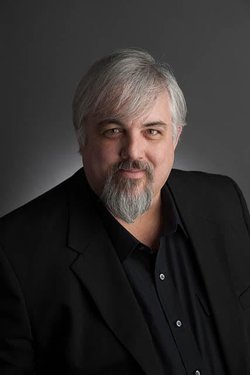 It started with George Wier speaking about writing action scenes. He’s literally a pro at this. Just read any of his books. (www.billtravismysteries.com) It wasn’t about how to describe a blow-by-blow fistfight. It was more about how to add tension to a scene, how to make it move along. I don’t know about you, but I like bullet points. So I’ll share my notes in that manner.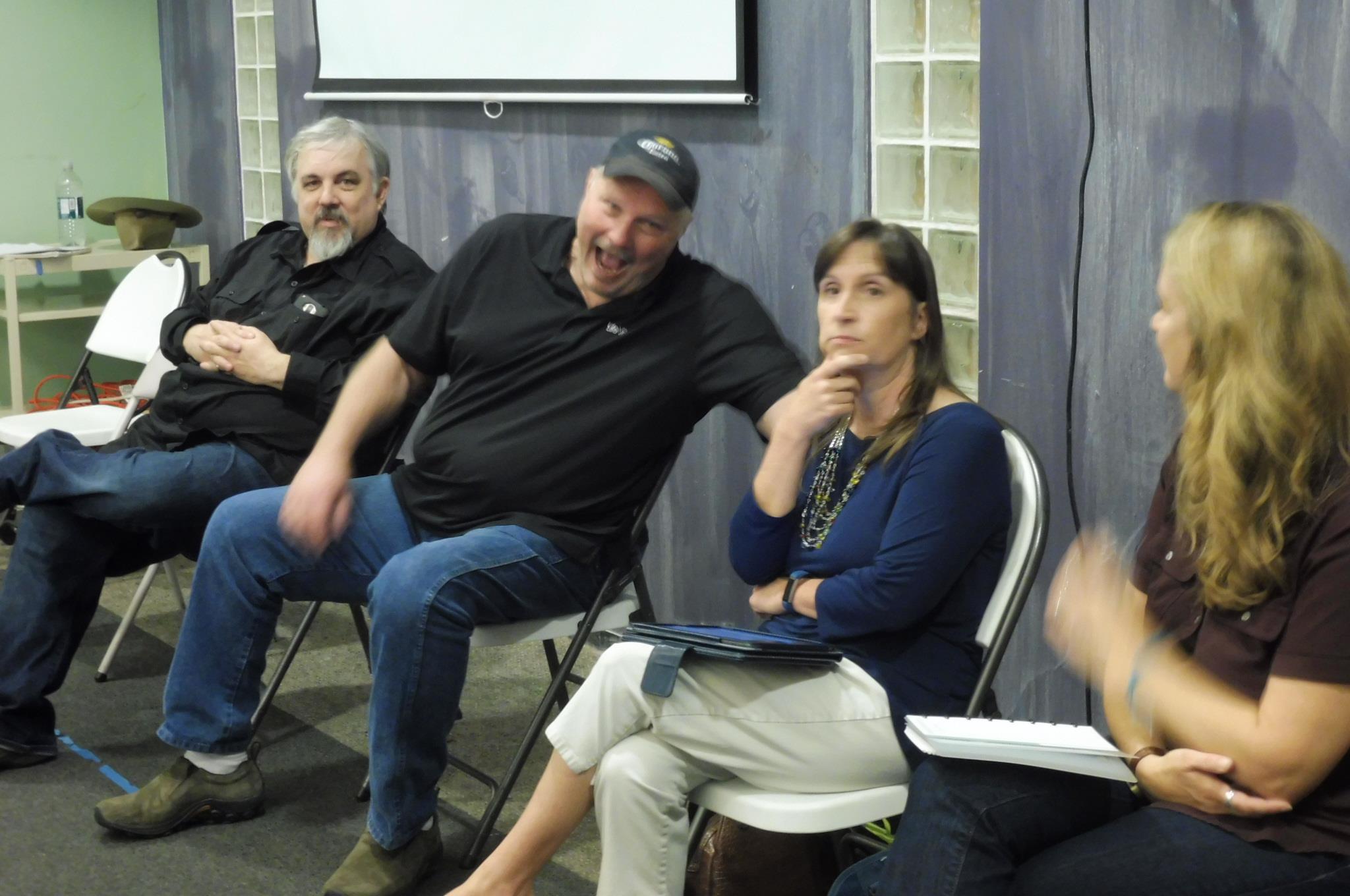
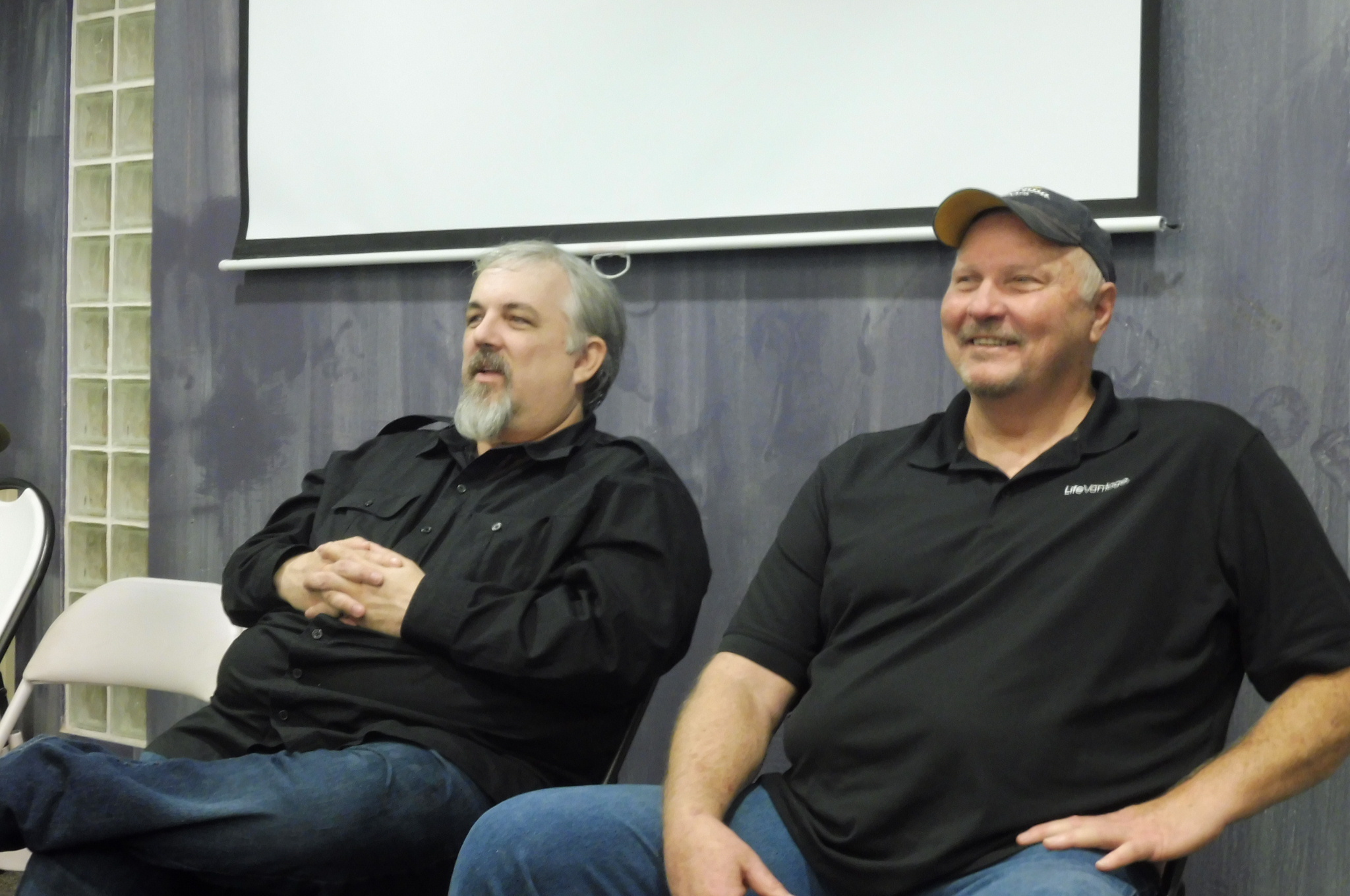
 The last event was a panel discussion that was very informal. It was about publishing, marketing, and networking. Honestly, I was so caught up in listening, I forgot to take notes! All the speakers were charming, personable, and informative. It was worth every moment that I was there.